Friday, October 28, 2016

A mosquito called Karan Johar and a super-giant called Mohammed Rafi.

Raju Korti
Ranbir loves Anushka but she meets with an accident and is thought of as dead. Aishwarya comes in RK's life after a break-up with Fawad and they fall in love with each other (what else?). Meanwhile, Aishwarys is critically ill and the only (intelligent) person who knows this is herself. Anushka comes back into Ranbir's life (what else) but meets with an accident again. A dying Aishwarya donates her organs and saves Anushka's life. Ranbir and Anushka name their child after Aishwarya. Fawad does what we all expect him to do even otherwise -- commit suicide.

Thus ends a stupid, puerile story which seems to be the work of some mentally retarded person. For someone who has a meritorious history of dishing out one trash film after the other -- and each worse than the earlier -- Karan Johar maintains his consistency to produce first class garbage as only he can. Right! Consistency is the virtue of an ass. Kabhi Khushi Kabhi Gham (which I fondly describe as Kabhi Khujli Kabhi Ghaam), Kuch Kuch Hota Hai, My Name is Khan, Student of the year -- and the torture continues -- come from the stable of a person who thinks no end of his alleged intellect and conscience. For all the articulate gibberish that he spouts in his silly interviews and ridiculous coffee-talk shows with frightening regularity, Johar's capacity to make biodegradable films is unmatched and legendary.
With Ae Dil Hai Mushkil, Johar keeps his congruence with absurdity and shallowness. But its not about his towering flap-doodle that I am interested in. His latest three-hour non-sense has a dialogue attributed to Anushka Sharma in the film: "Mohammed Rafi gaate kam aur rotey jyada the." This 44-year-old yet-to-grow-up dickhead was hardly eight when Rafi passed away and his Lahore-born father Yash Johar was just a non-descript face in the 4-lakh massive crowd that had gathered to pay its respects to India's greatest playback singer on the day he left the entire nation weeping. It was the biggest funeral in the history of Mumbai.Thirty-six years later, it has occurred to Johar's juvenile mind that Rafi sang less and sobbed more. The trouble with most of our film-makers is they expect people to gobble up, accept and appreciate their shit in the name of artistic expression. And if freedom of expression is the ultimate foundation of all debates, I will stand up to say my shit is most certainly better than yours.
If expressing an unreasonable opinion is artistic expression, our film-makers who never fail to carry the "liberal" badge on their sleeves, should take even the bitterest of criticism in their stride but what this tribe wants is only accolades. You criticise them and they start snorting like mad bulls, freedom of expression be damned. Let Johar enjoy as many births as he wants but he won't be able to do even a hundredth of what Rafi did in just five years of his forty-year career. Worst is he has demeaned an illustrious and legendary figure from his own crassly commercial industry. If this is what he thinks about a skyscraper of his own profession, one shudders to think what he thinks of others. That is if he can at all think and if what he calls inside his head as his mind.
I am sure like other ill-informed and half-baked of his tribe, this man will come out with a specious excuse that it is just a dialogue in the film and people need to understand from that perspective. What an astonishing drivel!
I understand one of the characters in the film wants to be a Mohammed Rafi. That's fine. Whether one wants to be a Rafi, Kishore or Sanu is one's call but that doesn't give one a licence to derogate anyone. If someone being inferior to others is the yardstick of others being superior, this man doesn't have a right to be anywhere near even a photo-shoot. The dialogue insulting Rafi is a cheap, poor and dreadful publicity stunt just to corner attention and capitalise on a debate that follows.
As a Rafi historian, I have chronicled the life and times of this great man in my book "God's Own Voice" and I can assure you that time produces such a personality only but once. Johar's father had not even thought of him (Karan) when Rafi was already the established real hero behind the gas-filled screen heroes. It is a measure of Johar's asininity that he has chosen to utter a name that his garrulous and slimy tongue is not worthy of. He himself belongs to the made-by-the-asses-for-the-masses clan.
For many, blasphemy and sacrilege are an easy option to gain limelight.Worse still, they know there is no shortage of label-head liberals who will defend them should they land in soup. Karan Johar chose to do it with a titan who is not alive to respond to it. Knowing Rafi, I am sure he would have maintained a dignified silence even in the wake of such a needless and abusive provocation but this deranged film-maker probably doesn't seem to know that Rafi's fans who are legion and only keep multiplying by the day, are not going to take this monumental hogwash in their stride. To them Rafi is a demi-god, no less.
Just how stupid it has got to is evident from the fact that the name of the film draws from Rafi's own song from CID (1956) "Ae dil hai mushkil jeena yahaan" which is still the signature song on Mumbai. If Rafi has sobbed in that song, Johar and his co-writer need an urgent appointment with an ENT expert. And maybe with a psychiatrist too.
      

Tuesday, September 27, 2016

In praise of our motormouth RJs

Raju Korti
With due apologies to all the radio jockeys and digital jockeys floating on air waves these days, each time the words are uttered, I am reminded of a popular brand of underwear. Apologies because for a garrulous and chatterbox RJ it is anything but an "aaram ka maamla." To hold forth for a long time with witless humour, inadequate information and puerile mimicry without any pause is no mean task. I am saying this at the risk of being panned by the huge fan clubs RJs have, especially among the younger generation. But then that is only fair given that anything before 1990 is old and archaic for today's youngsters.
Sketch from the net for only illustration purpose
The radio jockey has been an institution since the early 1930s in the West but in India, they became febrile only after the advent and proliferation of private radio stations. The temptation to use the word febrile was just irresistible with one of the FM channel called as 98.4 which we all know from our childhood is the normal body temperature.
I personally know a few RJs. What really strikes me about them generally is the supreme confidence and demeanour with which they handle their mikes. This is one section of the media where the radio anchors know they have said something wrong and believe people have not heard it. But to be fair to this clan, they more than make up with pun, spontaneity, fluency and a soothing voice. The job becomes that much more tricky given that RJs also have to raise topics of concern, design subjects for discussion and interact with callers and listeners via phone, email, social media and SMSs. Even a moment's monotony can break the spell. So talk, talk and talk till they themselves drop dead.
For someone who has never been able to summon the gumption to talk furiously, hardly breathing between the words, I have adulterated admiration for most RJs. If only they could do some home work before they launched into their verbal fusillade.
This morning I switched on my antique radio which stirred to life with an RJ on some FM channel (some because most are known by their frequencies) waxing eloquent on the country's most deified and somewhat vilified songstress Lata Mangeshkar, today being her birthday. The song selection meandered from the 1970s to 2010 making me feel I was older than the singer. You have to understand and feel the plight of senior citizens like me when one knows that the first song that she sung was almost a decade before I started walking in this mortal world.
That begs a question. Who does the ground work for programmes that call for deep research? Or is it that there is little or no research because the RJs can keep letting off their steam while we hapless listeners snort through the programme? But then, who wants (to) research when it is more important to run through the programme than be bothered with its content?
Today's programme on Lata was not without its humour -- inadvertent though. After every two songs, the RJ kept playing the lines from a Rafi song "Baar baar din ye aaye, tu jiye hazaaro saal, happy birthday to you." I am still trying to figure out who should be more mortified -- poor me or poor Rafi or poor Lata Mangeshkar. That calls for a vintage Lata song from Parichay (1954) "Jal ke dil khaak hua, aankh se roya na gaya."
I don't know if RJs are paid royalty but what is royal should get royalty. Simple logic.
    

Hook and crook of Trump-Clinton debate

Raju Korti
The sparring between presidential aspirants, Republican Donald Trump and Democratic Hillary Clinton, during the presidential debate yesterday reminds me of a James Hadley Chase thriller. The stronger boxer loses the fight because he does not remember the cardinal principle of boxing: When you hook with your right, make sure your left side is protected.
I doubt whether any presidential election has defied conventional wisdom in recent times as this one. For one, it pit a political neophyte and reality TV star against the better half of a former president and two, no other debate was perhaps as hotly anticipated for reasons more than one. Both didn't let down as acidic barbs flew thick and fast as expected since the Twitter was already an excited host to their fireworks.
In a preview of the combat on the small screen, both needled each other. Electoral planks and issues figured at the centre of what both claimed as outright lies. There has been enough evidence in the past that the first debate is compelling enough to make or mar a candidate. In majority campaigns in the television age, the opening debate has shaped the trajectory of the elections -- John Kennedy in 1960 and Ronald Reagan in 1980 being the prime examples. They typically have had the most impact when an incumbent president isn't running and when the candidates come in with something to prove and when the contest is close and fluid. I am not sure if there ever was a contest as close and as fluid as this one.
During the entire campaign, we saw Trump in two different avatars. The debate before the debate was about which Donald Trump would show up -- a provocative and outrageous Trump who unexpectedly claimed Republican nomination when there were at least a dozen others with stronger political resumes or the one who toned down his grandiloquent rhetoric in the run up to the debate. In the rough and tumble of such a mutated scenario, it is tricky to answer what made Trump pull even with Hillary on the national battleground. As is his wont, the original Trump showed up.
It was no surprise that the debate degenerating into a slang match,headed overtime with both the rivals socking each other in a fierce exchange. It was Trump as promised as he portrayed his foe as a political hack and describing her as all words and soundbites. The number of times he interrupted when she spoke would have given our own Arnabs, Rajdeeps and Barkhas a run for their money. The only difference was the moderator of the debate tried with only limited success to keep control.
Hillary's demeanour showed her as a counter-puncher. But she was bang on target when she painted Trump as a questionable businessman with no plans in his head and a limited grasp of facts. She too repeated jabs at Trump's "Trumped-up trickle down" economic policies and accused him of racist for questioning Obama's birthplace. But her best salvo was asking him what was he trying to hide by refusing to reveal his tax returns while they were being audited.
By far the most amusing spectacle was the two blaming each other for almost everything including except why they were born. Sample this:
Smiles before the scowls.

Trump: Mrs Clinton lacks presidential look and doesn't have the stamina.
Hillary: He can talk to me about stamina when he accomplishes as much. He has called women pigs, slobs and dogs.
Trump: I had planned to say something extremely rough to you and your family but decided against it.

Mercifully, Hillary didn't call Trump the son of a bitch and Trump didn't question her husband's stamina that was so much in evidence when he was having a fling with a 21-year-old White House intern. But while Trump huffed and puffed his way through, Hillary's responses were marked by more amusement than anger. Yet it was a debate between arrogance and experience if you know who should be the rightful claimant for those labels. In the complicated maze of truth, exaggeration and old falsehoods, it makes tactical sense for Hillary to let Trump caricature himself because no one else can do it better.
It is said that half of the American people have never read a newspaper. Half never voted for President. One hopes the other half uses discretion.

Sunday, September 25, 2016

Some thoughts about Pakistan and its nuclear threat

Raju Korti
Look at the picture, photo-shopped or not, accompanying this piece below. It makes light of Pakistan's military capability against India should there be a war. To me, it is a telling commentary on the economy of Pakistan -- a country clueless and /or impassive about tackling its own burgeoning domestic problems but never losing an opportunity to throw on India's face its readiness to press the nuclear button at the slightest provocation.
So what is it that makes this rather failed State, where non-State actors have been calling the shots for over two decades now, rely so furiously on the nuclear threat? Why does even something as routine as cancellation of talks for normalisation of bilateral relationship, makes it step on the gas and indulge in fulminations of a nuclear war?
Each nation has a doctrine to deal with possible nuclear threats. For Pakistan, it is majorly India. For India it is Pakistan and China. For the US it is Russia, China, North Korea and many more where it often pitches in as world policeman. On the brink given the problems that surround its neighbourhood and helpless because of an intransigent and crazy military establishment, this doctrine stares India in the face with alarming regularity. The number of Indians who believe that it is time for India to call Pakistan's bluff and get into a fight-to-finish war increases each time Pakistan perpetrates an outrage against Indian civilians and army. The threat of a full scale military offensive was never as pronounced as it is now after the attacks in Pathankot and Uri but the Indian response continues to remain calibrated and somewhat frustrated. Pakistan has nothing to lose. India far too much. The dynamics of what accrues between the two countries in the wake of their tumultuous division and subsequent deep-rooted hatred has gone far beyond the realms of conventional diplomacy.
There is still a faint glimmer of hope to believe that the Pakistani military establishment realises it would be a blunder to provoke an attack that would spell end to its country's existence on the world map. But it will not need much for the country's army -- which has thrown all civilian and democratic norms to the wind -- to acerbate a war having lost three wars in 1965, 1971 and 1994. What began as a bluster from then President Zulfiqar Ali Bhutto about staging a "thousand-year war with India" has now assumed a grotesque obsession to acquire nuclear weapons on the perceived threat from India. It seems to have gone unnoticed that there seems to be a perceptible change in the way Pakistan is seeking to harm India. The strategy now seems to be attack military installations rather than civilians.
If, after another terrorist attack on India, Indian army penetrates into Pakistan, inflicts heavy damages and occupies its territory, there is a lurking chance that Pakistan's army would use the nuclear deterrent to stop it. That is what prompts the general belief in India that defeating Pakistan below the threshold would perhaps avoid an escalation. But with Pakistan there are no guarantees. There is also a school of thought that isolating Pakistan as state sponsor of terrorism, slapping sanctions, economic embargoes, abrogation of the water treaty and withdrawal of Most Favoured Nation (MFN) status would be the best option. On the face of it, that sounds sensible since it supposedly reduces the risks of a major conflict but it does little to stop the elements that Pakistan has been shrugging off as non-State players. Diplomacy and terrorism pose challenges poles apart.
I am sold out on the theory that Pakistan should be allowed to die under its own weight. A debilitated economy and the ferment in Baluchistan, Karachi, Punjab are proof enough of its dysfunctional politics. Pakistanis are themselves not very optimistic about the country's future as a secure, developing and modern country. There is a talk that Pakistan relies on the US but they know that this economic and military aid is not without its pound of flesh. The Americans have always been prompted by their Geo-political interests that seek to serve their expedient politics. Delhi and Rawalpindi know this very well. As far as China is concerned, it is obvious that there has been some buttressing of Pakistan at State level but on other fronts there is scope for lot of justified scepticism. There is little social or cultural or emotional attachment between the peoples of the two countries. The Chinese don't have to be intelligent to know that Pakistan is a convenient shoulder to fire at India. They are known to pursue single-minded their own narrow interests. They do not contribute funding for health, education and other forms of development in Pakistan. In past crises with India, China is not known to have done even much of what Pakistani leaders wished. My gut feeling is China will not do anything to underwrite or protect Pakistan if it comes to a full fledged war. They know that the best weapon against any enemy is another enemy.
Crippled with inherent problems of militancy, unemployment and low growth rate, Pakistan lags behind India on almost all parameters of national growth. Raising the nuclear war bogey frequently is an attempt to show that its power emerges from its weaknesses within.
Pakistan can administer to itself a lethal injection and does not need any external threat to use it.      
Dire Straits of Pakistan (From Facebook)


Monday, September 5, 2016

Nothing Right, nothing Left in West Bengal

Raju Korti
Unlike the Left, which has a distinct ideology of its own -- acceptable or unacceptable -- the Trinamool can at best be described as Congress weed. Both of them do not seem to have any agenda in the state they have flourished except engage themselves in a war of words that often degenerates into a physical clash. A quick look at the Trinamool Congress' website shows that its main discourse is Islamic fundamentalism, Populism and Democratic Socialism, not necessarily in the same order all the time. Do not bother to exercise your grey cells what those mean because Trinamool leaders themselves have no clue.
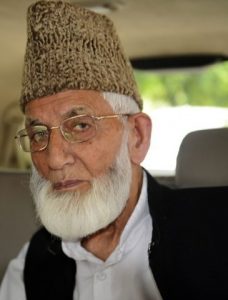
Syed Shah Geelani (file grab)
The long-standing rivalry between the TC and the Left, amusingly, often brings them on the same platform to take swipes at each other. The latest trigger comes in the wake of the leaders of both parties desperately wanting to seek an audience with Kashmiri separatist leader Syed Ali Shah Geelani through an all-party delegation. Trinamool leader Saugata Roy hurriedly opted out of the delegation when he came to know that CPM leader Sitaram Yechury was also a part of the team.
The Trinamool has nothing to do in West Bengal despite being in power while the Left is gainfully unemployed in the state which was its bastion for decades. Having more or less a similar mindset and yet being political rivals, it would have been very amusing how the two parties would have taken their agendas further during the meet with Geelani.
For all their political wisdom, both did not realise that Geelani was fuming while he turned down J&K Chief Minister Mehbooba Mufti's invitation for talks on the Kashmir issue. The delegation was reduced to a comedy of sorts with four of its opposition MPs breaking away from the group and deciding to reach out Geelani separately. Separatists meeting a separatist leader?
Obviously the all-party delegation with assorted biscuits like CPM leader Yechury, CPI leader Raja, JD (U) leader Sharad Yadav and RJD leader Jay Prakash Narayan headed by -- of all the people -- Rajnath Singh -- did not have the common sense to understand that a hardened separatist leader placed under house arrest would be the last person to meet them.
Roy did not miss the chance to take potshots at Yechury. He said "Yechuri had to do all this because the CPM has nothing 'left' in West Bengal now. But the tug of war between the two reminds me of an archetypal story I read in children's magazine as a schoolboy.
A king on the deathbed tells his prince son to tour the country, see how administration functions and gain some experience before ascending the throne. The prince sets out for the tour and after a hard day's horse-ride decides to sleep under a tree. When he is fast asleep, two cobras emerge, happy that they had someone to bite after a long time. However, they start fighting, hissing loudly over who should bite him first. Hearing the commotion, the prince wakes up and kills both with his sword.
Moral of the story: Strange bedfellows never make for holy alliances. The end.

Monday, August 15, 2016

Some thoughts about cynicism

Raju Korti
If there were to be a University for Cynicism, I would be its Dean for lifetime. This rare qualification came to me from my father who died without making a will, but he bequeathed this property to me as his sole heir. He would often tell me: "You see son, there is always someone who is worse than you" and my response invariably would be "so what?"
A cynic is a person, who when he smells flowers, thinks there is a coffin around. The Oxford Dictionary couldn't have found a suitable mascot for the word. It is not easy to be convinced and sceptical enough to believe that the future is bleak and people act only out of self interests all the time. I am waiting for the day when friends and relatives who keep bombarding me with motivational quotes and essays on positivism day in day out, scratch the cynic in me. They will sure find a disappointed idealist.
A journalist which I have been for more than half my life, requires a fair tempering of cynicism. It is a scientific temper of a craft that often calls for keen observation of people and surroundings in every conceivable situation. It is also a touchstone of a journalist's alchemy through which he hopes to discover a non-existent bunkum called objectivity. The only true objective journalist is the dead one.
Having banged my head in the profession for more than three decades, I have come to realise that cynicism is a shield which a journalist wraps around himself for protection. There is no one more enlightened than a disillusioned journalist. Not that there is anything special about the people who deal with news. They are as dishonest, noble, cowardly, mean, ridiculous, courageous and truthful as the ordinary run of the people but in their case, cynicism also masquerades as wisdom as it has done in my case.
The trigger for this diminutive blog is a post I wrote on Facebook today, the Independence Day. I wrote "Hail our martyrs for one day. Debate their credentials for the rest of the year." Friends "liked" it but I am not too sure they appreciated. Truth and choice do not necessarily make for great companions. Knowing me as a die-hard cynic, they have probably given up on me as a bad joke. That spurs my cynicism to newer heights. Or newer depths.
It takes a clever man to turn a cynic and a wise man to be clever enough not to.

Friday, August 12, 2016

Making a song and dance about Vyjayanthimala

Raju Korti
Some time around 1987 when Ms Twinkle Toes Vyjayanthimala was done with her long but eventful career in films, I happened to meet the lady more by fluke than design.
In (then) Madras for a professional commitment, I was told that the dance academy "Kalakshetra" run by the nimble-footed actress happened to be close by. My impulsive decision to go and have an informal chat with the actress was also governed by justified apprehension, having heard any number of stories about her idiosyncrasies and unpredictable ways. Later, actor-director Vijay Anand had told me about the "tough time" she had given during the making of 1967 hit Jewel Thief. She had been dating Dr Bali (whom she later married) and would often disappear in the midst of the shootings.
As expected, Vyjayanthimala welcomed me with a frosty smile but put on a friendly demeanour in no time. I strongly suspect that my association with The Hindu and being a south Indian catalysed her into warming up faster than she did with many of my tribe. I didn't beat around the bush. You don't do that with someone blunt like Vyjayanthimala. I told her I was overawed by her dancing skills and was keen to know how she could blend those with all those evocative numbers she sang on-screen.
It immediately stuck me that she was a dancer from head to feet. So while I sauntered around, she waltzed her way while showing the Academy. The way her disciples reacted to her presence made me feel she was a goddess to them, no less. I broached the conversation in a way that instantly got her animated. I sought to brush up her memory with a song sequence from Leader (1962) where she swishes her steps on the stones in a pond. She cut me off with a wave of her hand. “Look at the larger picture. I was blessed to be able to articulate so many divine numbers that came my way. The one film that showcased the real me was Aamrapali where I played the royal courtesan. I just danced and sang my way through that film. Thanks to Shankar-Jaikishenji who got four ethereally beautiful Lataji solos composed for me. Jao re jogi tum jao re, Tumhe yaad karte karte, Neel gagan ki chhaon mein and Tadap ye din raatki. When these songs were being rehearsed, I would often take time off my acting schedules to be present at the recording room. I was an established dancer already, but Jao re jogi spurred me to greater heights.”But didn't you put so much passion and gusto in that nine-minute dance-song from Jewel Thief Hoton mein aisi baat mai dabaake chali aayee (1967 with Dev Anand)”, I responded weakly. “You think so? It was a great song, great composition and I had to summon all my energies to do that. But there was more folk and less classical in that song. I recall I had winked at Devsaab after the song was pictured and told him how I had beaten him in the song. And when he carried the reputation of being a bundle of energy himself..”
The mention of Bimal Roy's Chandramukhi she essayed in 1955 made her nostalgic. “Oh yes. There was this classic Burmandada composition: Jise to qubool kar le wo adaa kahaan se laun." The feisty actress had refused to accept that year's Best Supporting Actress award since her role was as important and had the same footage as Suchitra Sen.
Vyjayanthimala was born to dance. If anyone thought that she was cut out for only Bharat Natyam and Arangetrums, you were mistaken. The tall, stately dancer born in an orthodox Tamil Brahmin family, could carry off even peppy numbers like Mai kaa karoo ram mujhe Buddha mil gaya. “The song had not been particularly appreciated by the Censors given its innunedoes, Besides, both me and Lata were known for our fastidious ways. Probably the audience couldn’t reconcile to the dance I did in short slacks and a seductive top. It was panned by critics as vulgar. And to think of the crude dances choreographed these days”.  The actress recalled that among her other films where she made a great team with Lata was Nagin (1954 with Pradeep Kumar), Madhumati (1958 with Dilip Kumar), Amar Deep (1958 with Dev Anand , Kathputli (1959 with Balraj Sahni), Gunga Jumna (1960 with Dilip Kumar), Dr Vidya (1962 with Manoj Kumar).
No surprise she seemed to have particularly fond memories of Madhumati and singled out Salil Choudhury’s folk song-dance sequence Zulmi sang aankh ladi. “Aaja re pardesi was, of course, more haunting. But I loved doing  Zulmi sang aankh ladi and Ghadi ghadi mora dil dhadke.”
As the conversation got intense, I told her something that really made her stood up, her pink face lit up like a smitten teenager: Lata Mangeshkar says that Vyjayanthimala was among the actresses who did full justice to her songs.”
“Oh really? You made my day. Looking back, I realise her contribution to my on-screen success. Even Asha Bhosale sang for me in films like Naya Daur, but I think Lataji suited me best. Her voice had so much sobriety. Among my non-dance numbers, I rate her Aurat ne jam diya mardon ko (1960 Sadhana) as an all time classic.”
Vyjayanthimala has bowed out from the celluloid but her footprints linger. She still dances as gracefully and her sprightly movements can put even the youngest of dancers to shame. A lesser known fact is she is also also a trained Carnatic singer.
So here is to Vyjayanthimala on her 80th birthday.              
      
Madhumati for a lifetime (File grab)


Mecca Agreement: Merely a symbolic alliance or deterrent?

Raju Korti The signing of the Mecca Joint Defence Agreement by Saudi Arabia, Turkey and Pakistan has all the ingredients of a geopolitical e...